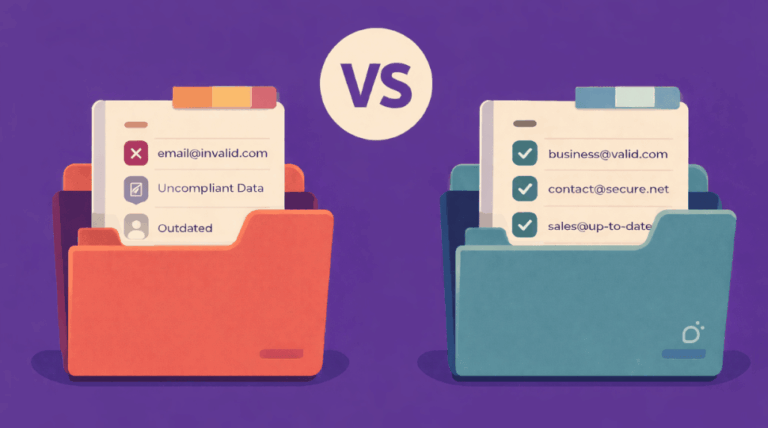
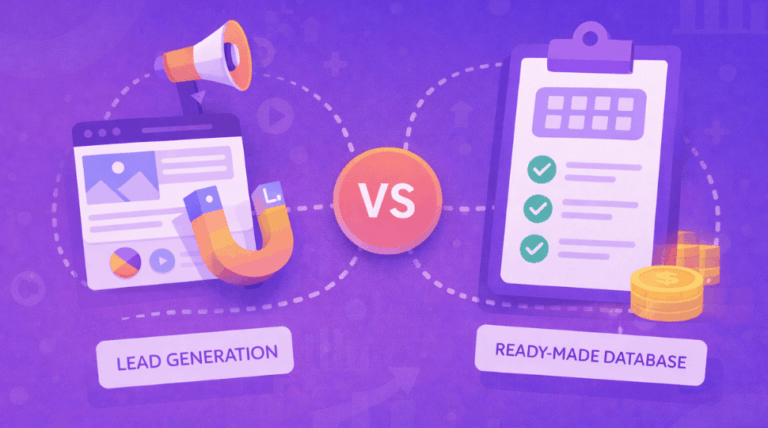
Choosing a B2B database means choosing data quality. Contacts become outdated as roles, companies, domains and details change. That’s why value depends not just on volume, but on accuracy, validation, segmentation, traceability and continuous updates – all of which directly affect deliverability, targeting and ROI.
B2B Email Marketing Databases: What to Evaluate Before Buying
In B2B marketing, choosing a database of business contacts is never just a matter of volume. It is a strategic decision that can affect every campaign that follows: open rates, clicks, deliverability, domain reputation and ultimately overall ROI.
Yet many marketers still rely on improvised lists or data providers that offer little transparency about where their information comes from. The result can be high bounce rates, spam complaints and inconsistent campaign performance.
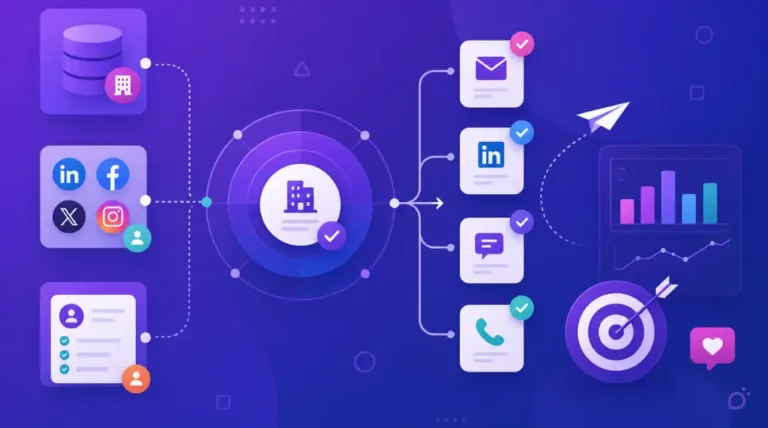
A professional B2B email database should therefore do more than provide a large number of contacts. It should make it possible to identify the right companies, understand how the data was collected and validated, and activate it effectively within an email marketing strategy.
In this guide, created through the collaboration between Bancomail and MailSenpai, we look at how to choose a high-quality B2B database and how to integrate it correctly into an email marketing platform, while avoiding the most common mistakes.
1. Why database quality determines the real ROI of email marketing
In B2B marketing, data only has value when it is reliable. Every incorrect or outdated record is more than wasted spend: it can increase bounce rates, damage sender reputation and reduce email deliverability.
A high-quality B2B database should therefore be assessed not by the number of records it contains, but by its accuracy, freshness, validation and relevance to the target audience.
A study cited by HubSpot estimates that more than 22% of B2B data can decay every year as people change roles, companies close or merge, domains change and contact information becomes outdated.
Businesses that choose a database solely because it is inexpensive may end up paying twice: first for the contacts themselves, then for the consequences of poor delivery rates, damaged sender reputation and misleading engagement metrics.
2. How to choose a B2B database
Before you buy a B2B email list, four factors deserve particular attention: data sources, filtering options, validation processes and the way the database is kept up to date.
Data sources: transparency comes first
A reliable data provider should be able to answer one simple question clearly:
Where do the business records come from?
Bancomail uses public, semi-public and direct sources, including company websites, official directories, business registries, industry portals and direct data acquisition. These sources are combined with proprietary data enrichment processes to add information that can be useful for B2B marketing, such as sector classifications, company size and technology-related attributes.
The Bancomail Database Policy provides further context on the way data is managed and processed.
Traceability is equally important. Each record should have a clear origin and verification path so that businesses can evaluate how it can be used and document their approach if required.
For organisations operating in Europe or targeting European companies, GDPR compliance for B2B databases is therefore a fundamental part of the evaluation process.
Filters and segmentation: the real competitive advantage
Buying a business database should not mean sending the same message to everyone.
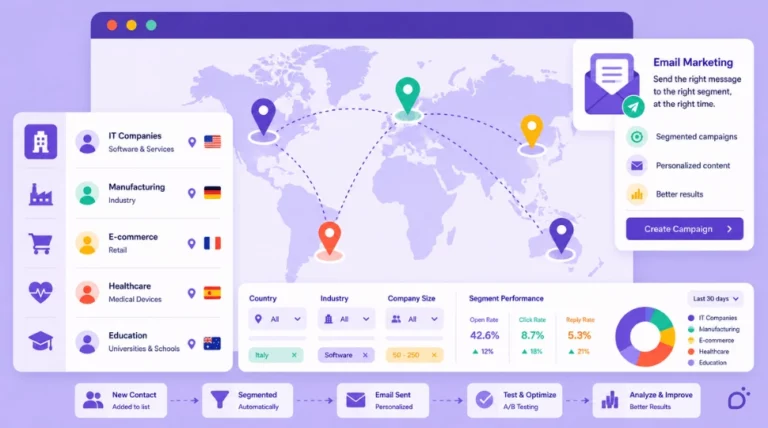
The real strength of a professional data provider lies in advanced profiling and segmentation. Businesses can be selected according to criteria such as country, region, industry, company size, specific business activity and, where available, technologies in use, including CMS platforms, ecommerce systems and payment technologies.
This makes it possible to build B2B email databases by industry that are much more closely aligned with a campaign’s actual target market.
For example, if your software integrates with Shopify or WooCommerce, targeting companies that use those platforms can significantly reduce irrelevant outreach compared with a generic ecommerce list.
Geography can then be combined with the same criteria. A company entering the UK market can build its audience from business contacts in the United Kingdom and refine the selection by industry, company size or other relevant attributes.
For a campaign focused on North America, the same segmentation logic can be applied to business contacts in the United States, keeping the audience aligned with the territory and commercial objective.
Validation: where data quality becomes deliverability
A perfectly segmented list is of little value if the emails never reach their destination.
Bancomail applies 21 automated and manual validation steps to its records, including:
- deduplication;
- DNS and MX checks;
- spam-trap and catch-all controls;
- syntactic and semantic checks;
- SMTP connection tests without sending an actual message.
These controls are complemented by periodic verification through Bancomail’s proprietary Email Validator technology, designed to keep the database active and clean over time.
The data validation and warranty framework adds a contractual layer to the technical controls and provides protection for invalid addresses according to the applicable guarantee conditions.
Typical result reported in the source article: deliverability above 97% and bounce rates below 3%, with invalid contacts covered under Bancomail’s contractual guarantee conditions.
Static list vs. living database
One common mistake is to purchase a list once and continue using exactly the same data for years.
Markets change, and business data changes with them. Domains are replaced, offices close, companies merge, employees change roles and contact details stop working. A professional B2B database must therefore be continuously updated and revalidated.
Bancomail supports dynamic data management through periodic updates and B2B database API integration, making it possible to keep data flows connected to other business systems instead of repeatedly rebuilding a database from scratch.
3. How to integrate data into your email marketing platform
Once you have selected a reliable database, the next step is to import and structure it correctly inside your email marketing platform.
This may sound straightforward, but the quality of the integration directly affects segmentation, automation and ultimately deliverability.
MailSenpai provides the environment needed to import structured B2B data and turn it into segments, campaigns and automated workflows.
CSV import: simple, but not superficial
The most immediate way to load data into MailSenpai is through a CSV file. A structured file can include fields such as email address, company name, industry, geographic information and additional profiling attributes.
Before importing any database, it is normally good practice to check the file format, encoding and consistency of each field.
When the data comes from Bancomail, the files are already prepared with several useful characteristics:
- UTF-8 encoding;
- duplicates removed;
- standardised headers for easier import.
During the import process, MailSenpai can map the available columns to custom attributes. Once the data has been loaded, those attributes can immediately be used to create dynamic segments and automation triggers.
API integration: when data moves automatically
For businesses running recurring campaigns or working with a CRM that changes continuously, an API-based process can be more efficient than repeated manual imports.
A REST API can support workflows such as:
- synchronising new contacts in real time;
- updating or removing records automatically;
- retrieving campaign reports and delivery statuses.
This approach reduces manual errors and helps keep information consistent across systems such as a CRM, a B2B data source and an email marketing platform.
Real-world case from the original article: a SaaS company that synchronised new CRM leads with MailSenpai every week reduced bounces by 35% and improved open rates by 28% through API automation.
Validation and cleaning on import
MailSenpai performs automated quality checks on imported addresses, including checks for domains or IPs reported on global blacklists. Its system uses an aggregated collection of monitoring data that is continuously updated over time.
The purpose of this additional control layer is to identify problematic addresses early, reduce bounce risk and protect sender reputation.
When the source is Bancomail, much of this validation has already happened upstream: the addresses have been checked before delivery, while MailSenpai’s controls provide an additional safeguard during campaign activation.
Dynamic segmentation and automation
Once the database has been imported, the information can be turned into a dynamic campaign resource rather than remaining a static contact list.
Segments can be built around criteria such as:
- industry;
- company size;
- geographic market;
- previous opens or clicks;
- engagement score.
These segments can then support automated workflows. A structured email marketing automation strategy can include:
- targeted follow-ups for contacts who opened but did not click;
- progressive nurturing campaigns for new leads;
- reminders or tailored offers for inactive contacts.
4. Data + platform: why the combination matters
The real value of the Bancomail and MailSenpai partnership comes from connecting data with action.
- Bancomail provides the foundation: verified, segmented and continuously maintained B2B data.
- MailSenpai provides the environment in which that data can be activated through campaigns, testing and automation.
The connection between the two is strategy: knowing exactly who to contact, in which market, at what point and with which message.
Practical example
Imagine a SaaS company that provides workflow software to small and medium-sized businesses and wants to develop new B2B opportunities in both the UK and US markets.
- Through Bancomail, it selects companies with 10-50 employees in professional services and retail.
- It creates separate geographic audiences for the United Kingdom and United States, so each campaign can reflect the market it is targeting.
- Within those audiences, it applies a size filter based on annual revenue – for example, more than £2.5 million in the UK or $2.5 million in the US – to identify companies with a suitable profile for the SaaS offer.
- The contacts are imported into MailSenpai via CSV.
- The campaign uses a subject-line A/B test and automated follow-ups for contacts who open but do not click.
- In the example from the original article, after ten days the campaign records a 42% open rate and a 9.8% CTR.
This is the potential of an ecosystem built on solid foundations: reliable data combined with the tools required to activate and measure it.
5. Mistakes to avoid when choosing and integrating a database
Even strong data and advanced tools can produce poor results when the underlying process is wrong.
- Buying generic or unverified databases: this increases the risk of deliverability problems and GDPR issues.
- Ignoring segmentation: sending the same message to every company reduces relevance and response rates.
- Failing to keep data updated: according to the source article, around 2-3% of contacts can change status or domain every month.
- Importing data without cleaning it first: clusters of invalid addresses can negatively affect an entire campaign.
- Skipping integration tests: before launching at scale, test the workflow with a controlled group of around 50-100 contacts to verify field mapping, automation and tracking.
6. The competitive advantage of proprietary data
In B2B marketing, data is not simply an operational resource. Over time, it can become a sustainable competitive advantage.
Building and managing a qualified contact base within your own marketing ecosystem means reducing dependence on temporary lists, external platforms and disconnected data sources.
When a company starts with data supplied by a structured provider such as Bancomail and integrates that data into its own ecosystem through a platform such as MailSenpai, the database begins to accumulate additional information from real campaigns.
Opens, clicks, responses, conversions and segment performance enrich the original profile. Over time, the initial database evolves into a form of proprietary marketing intelligence that reflects how specific audiences, territories and messages actually perform.
7. From data selection to activation: 20% off MailSenpai for Bancomail customers
Choosing the right B2B database means investing in the long-term performance of your email marketing. Reliable data today becomes the foundation for better campaigns, cleaner segmentation and more effective automation tomorrow.
With Bancomail, the process starts with verified and profiled B2B data. With MailSenpai, that data can then be imported, segmented, activated and measured within an email marketing workflow.
The shared objective is simple: turn data into action.
Bancomail customers get 20% off MailSenpai – request your discount code

Francesca Grillo
With a hybrid background in visual design, marketing, and product management, Francesca works at Bancomail as Project Manager and Product Owner, leading digital development and lead generation strategies. For over 15 years, she has operated in both B2B and B2C contexts, focusing on email marketing, process optimization, and customer experience. She is part of Bancomail’s internal B2B Marketing Board and actively contributes to the growth of the company’s ecosystem, with a sharp focus on data value and communication quality. Passionate about writing and nonprofit digital projects, she believes in blending technical vision with narrative sensitivity.