In 2026, a first-CTA conversion rate between 0.4% and 0.8% represents a good result for a B2B cold email campaign. Higher performance depends primarily on database quality, segmentation, deliverability, offer relevance and the level of commitment required by the call to action.
Cold Email in 2026: What Is the Average CTA Conversion Rate?
What is a good conversion rate for a B2B cold email campaign in 2026? When conversion means the first action completed through the email’s primary CTA, a rate between 0.4% and 0.8% represents a good result. Well-segmented campaigns built on reliable data and a relevant offer can reach or exceed 1%.
There is no single benchmark that applies to every campaign. A conversion may be a click, a qualified reply, an information request, a resource download or a booked sales call. Before analysing performance, it is essential to define which action represents the first meaningful conversion.
What is the first-CTA conversion rate?
The first-CTA conversion rate is the percentage of recipients who complete the main action requested in a cold email.
The formula is:
Conversion rate = conversions generated by the CTA / delivered emails x 100
If a campaign generates 70 conversions from 10,000 successfully delivered emails, the conversion rate is 0.7%.
Common B2B cold email conversions include:
- a qualified reply;
- a click to a landing page;
- an information request;
- a content download;
- a booked sales call;
- a demo or quote request.
These actions do not have the same commercial value. A click indicates interest, a positive reply signals stronger intent, and a booked call already represents progress within the sales funnel.
What is a realistic cold email conversion rate in 2026?
Cold email benchmarks must be interpreted according to industry, geographic market, database quality, deliverability, domain reputation, offer relevance and the level of commitment required by the CTA.
As an operational reference, first-CTA conversion rates can be assessed using the following ranges:
- 0.1%-0.3% – low performance: common in campaigns with weak targeting, generic messaging or outdated data.
- 0.4%-0.8% – good performance: generally indicates a coherent target, a clear CTA and a sufficiently relevant offer.
- 0.9%-1.5% – very good performance: typical of well-segmented campaigns addressing a recognisable business need.
- 1.6%-2.5% – excellent performance: achievable with vertical segments, highly relevant offers and low-friction CTAs.
- Above 2.5% – exceptional performance: more common in narrow niches, small targeted lists or highly personalised outreach.
These percentages are not an absolute score. A 0.5% conversion rate may be highly profitable when the average customer value is high. The same percentage may be insufficient for low-ticket services with limited margins.
The benchmark must therefore be assessed alongside the economic value and quality of the opportunities generated.
Why the CTA determines cold email performance
The CTA is the point where interest must become measurable action. Many campaigns fail not because the service is irrelevant, but because they ask for too much, too soon, or fail to explain the benefit of taking the next step.
A request such as “Book a 45-minute demo” may create excessive friction for a recipient who does not yet know the sender. A generic CTA such as “Learn more” does not provide a clear reason to act.
The first email should normally suggest a simple action that is proportionate to the current level of trust:
- “Would a sample database for your industry be useful?”;
- “Can I send you a case study from a similar market?”;
- “Would it be useful to explore this point further?”;
- “Can I send you a more specific selection?”.
This approach does not weaken the commercial objective. It divides it into smaller steps that are more appropriate for a cold relationship.
Clicks, replies or meetings: which conversion should you measure?
The primary metric depends on the campaign objective. To avoid misleading conclusions, it is useful to separate three conversion levels.
1. Micro-conversion
A micro-conversion is the first observable interaction, such as a click, a landing-page visit or a resource view. It signals interest but not necessarily commercial intent.
2. Initial commercial conversion
This category includes positive replies, information requests, service-related questions and sample requests. It provides a clearer indication of the quality of the offer.
3. Advanced conversion
This includes booked calls, requested demos, initiated quotes and opportunities transferred to the sales team.
Combining all these actions under a single conversion metric makes it difficult to identify where the campaign is working and where the funnel is losing prospects.
The main factors affecting conversion rate
Database quality
An effective message sent to the wrong audience is unlikely to convert. A relevant B2B database improves targeting accuracy, segmentation, deliverability and the probability of generating a qualified response.
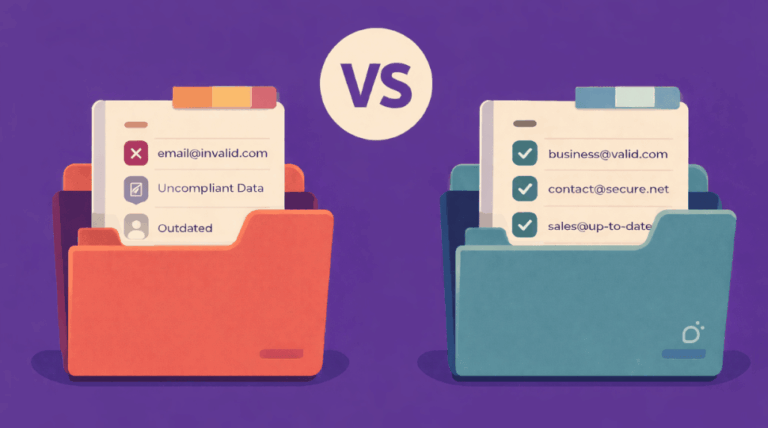
Database quality is not limited to the presence of an email address. It also depends on accurate company information, reliable industry classification and the availability of attributes that help distinguish different business profiles. Reviewing a B2B dataset sample helps determine whether the available fields support the intended targeting strategy.
Segmentation
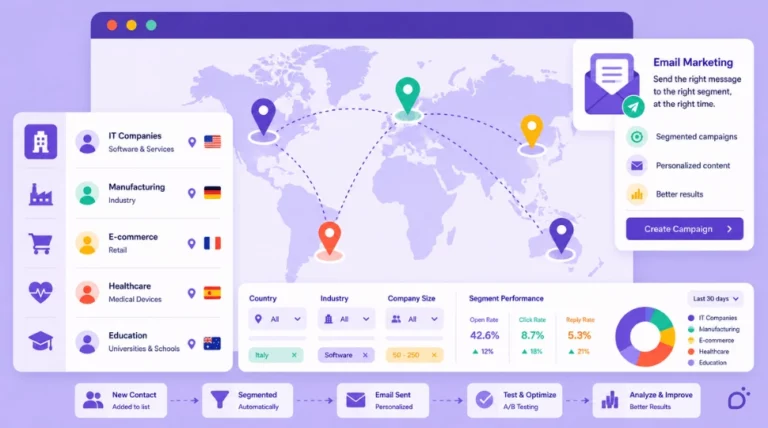
Segmentation allows marketers to adapt the message and CTA to groups of genuinely comparable companies. Industry, company size, location, technology usage, ecommerce activity and website characteristics can significantly change how a proposal is perceived.
For example, a UK campaign may begin with a targeted company email list for the United Kingdom, but geography alone is rarely enough. The list should also be filtered using criteria that reflect the offer and the businesses most likely to need it. The same principle applies to campaigns targeting the United States.
Alignment between problem and offer
A CTA converts when it follows a recognisable problem and presents a concrete benefit. A generic statement such as “Discover our solutions to increase sales” communicates less value than a specific proposal:
“Would you like to see a company list filtered by industry, location and technology usage?”
The second version reduces uncertainty and makes the value of the requested action immediately clear.
CTA friction
Every CTA requires a different level of commitment:
- Low-friction CTA: “Would you like me to send an example?”;
- Medium-friction CTA: “Would a tailored proposal be useful?”;
- High-friction CTA: “Book a 15-minute call”.
The colder the relationship, the simpler the first step should be. Follow-up emails can progressively introduce stronger requests.
Deliverability
If the email does not reach the inbox, the CTA cannot convert. Conversion rate must therefore be analysed alongside bounce rate, email quality, domain reputation, sending configuration and campaign frequency.
Low performance does not always indicate a copywriting problem. It may point to a delivery issue that occurs before the message is opened. Data validation and email quality procedures help reduce this risk before a campaign is activated.
Practical example: more clicks do not always create more opportunities
Consider two campaigns, each with 20,000 delivered emails.
Scenario A
- 160 CTA clicks – 0.8%;
- 22 qualified requests – 0.11%;
- 6 booked calls – 0.03%.
Scenario B
- 90 CTA clicks – 0.45%;
- 35 qualified requests – 0.175%;
- 14 booked calls – 0.07%.
Scenario B generates fewer clicks but more qualified requests and more meetings. This shows that the most effective CTA is not necessarily the most clicked one, but the one that moves the right prospect towards the next commercial step.
Cold email in 2025 vs 2026: what has changed?
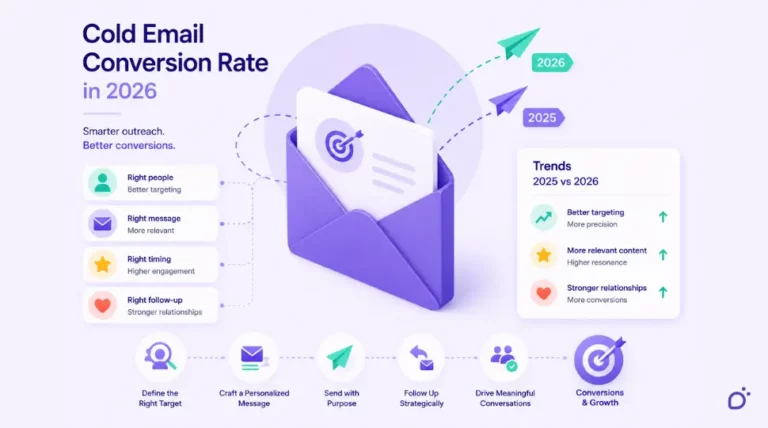
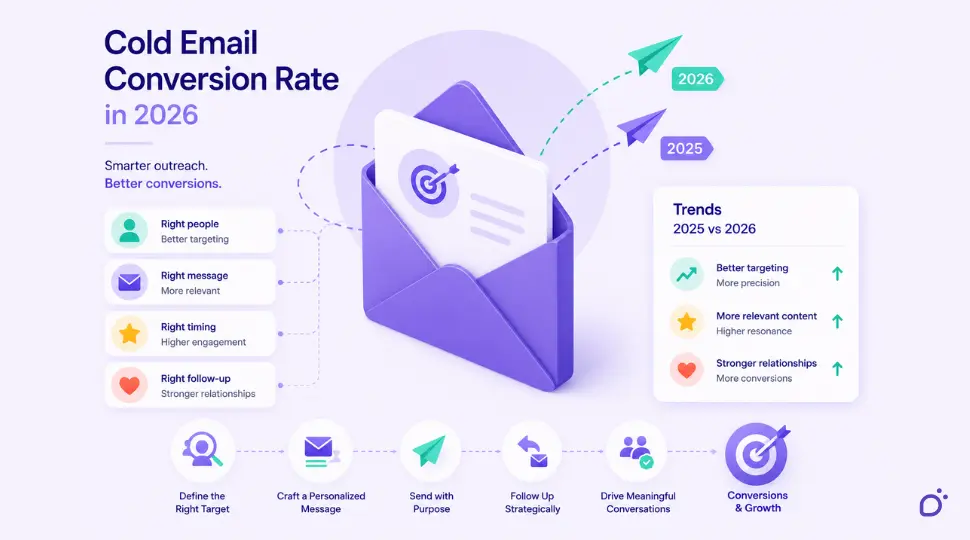
Cold email does not necessarily convert less in 2026 than it did in 2025. It can produce stronger results, but campaign performance now depends more heavily on decisions made before sending.
Tools for email verification, company enrichment, vertical segmentation and contextual personalisation make targeting more accurate. As a result, performance depends less on volume alone and more on the quality of the selected audience.
| Area | Cold email in 2025 | Cold email in 2026 |
|---|---|---|
| Target selection | Broad demographic and industry criteria | Specific filters, enriched data and vertical segments |
| Use of AI | Copy and follow-up generation | Support for analysis, personalisation and optimisation |
| Segmentation | Important | Critical |
| Database quality | Highly relevant | Strategic |
| Personalisation | Name, role and company | Industry, technology, business characteristics and context |
| Typical CTA | Direct demo or meeting request | Simple and proportionate first step |
| Main metric | Click rate and reply rate | Qualified conversion and funnel progression |
| Campaign strategy | Balance between volume, copy and follow-ups | Integration of data, segmentation, deliverability, offer and CTA |
The shift from 2025 to 2026 does not represent the decline of cold email. It reflects the transition from a mainly volume-based model to one in which database quality, relevance and segmentation determine the value of each message sent.
Why open rate matters less in 2026
Open rate has become an increasingly imperfect metric. Privacy systems, proxy servers, automatic image loading and security software may record opens that do not correspond to real human activity.
Open rate remains useful as a general technical indicator, but it does not demonstrate commercial interest. Campaign analysis should focus primarily on:
- genuine clicks;
- human replies;
- positive replies;
- qualified requests;
- booked meetings;
- sales opportunities generated.
The most useful question is no longer simply “How many recipients opened the email?”, but “How many completed the action requested?”.
AI and personalisation: context creates the advantage
Artificial intelligence makes it possible to generate subject lines, messages and follow-ups quickly. This has increased the quantity of email content produced, but not automatically its relevance.
In 2026, the competitive advantage comes from the quality of the information used to decide who to contact, which business need to address, which offer to present and which CTA to use.
Effective personalisation has therefore moved from text to context. Adding the recipient’s name or company is no longer enough. The message should reflect concrete factors such as industry, company size, territory, technology usage, ecommerce presence and business model.
A short message can be highly personalised when it reaches the correct segment. A detailed AI-generated email may still feel generic when the targeting is weak.
How to improve cold email conversion rates
- Define one primary conversion for the campaign and separate it from clicks and other micro-interactions.
- Select companies that match the offer instead of increasing volume without clear criteria.
- Segment the database by industry, geography, company size and other relevant attributes.
- Connect the CTA to an immediate benefit and avoid vague requests.
- Reduce the commitment required by the first email and strengthen the CTA gradually through follow-ups.
- Check data quality and deliverability before attributing poor performance to the copy.
- Measure positive replies and commercial opportunities, not only opens and clicks.
A practical guide on how to send a cold email campaign can help align targeting, message structure, delivery and response management. Cold outreach must also follow the applicable permission marketing rules and data protection requirements.
Conclusion
In 2026, a first-CTA conversion rate between 0.4% and 0.8% provides a useful benchmark for a good B2B cold email campaign. The figure becomes meaningful only when it is linked to the type of action requested, the quality of the resulting opportunities and their commercial value.
Cold email does not reward the company that sends the most messages. It rewards the company that uses better data to identify relevant businesses, build a credible proposal and request an appropriate first step.
Conversion begins before the CTA. It begins with selecting the right recipient.

Francesca Grillo
With a hybrid background in visual design, marketing, and product management, Francesca works at Bancomail as Project Manager and Product Owner, leading digital development and lead generation strategies. For over 15 years, she has operated in both B2B and B2C contexts, focusing on email marketing, process optimization, and customer experience. She is part of Bancomail’s internal B2B Marketing Board and actively contributes to the growth of the company’s ecosystem, with a sharp focus on data value and communication quality. Passionate about writing and nonprofit digital projects, she believes in blending technical vision with narrative sensitivity.