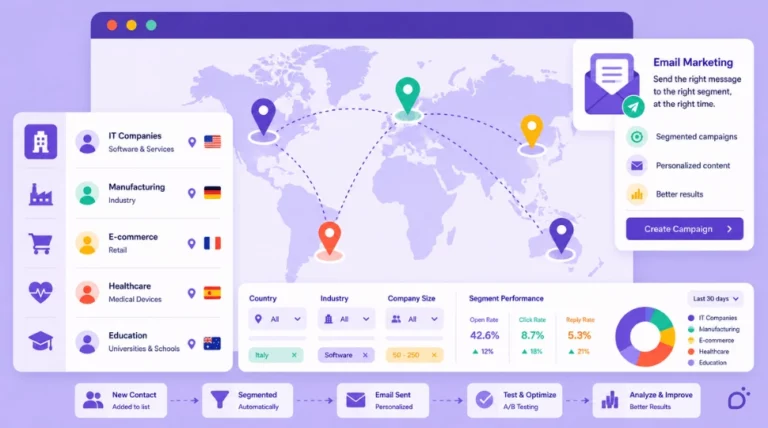
In B2B email marketing, timing drives performance more than volume: the same message performs differently in pre-season, peak, and post-season phases. High-performing campaigns show tangible outcomes (lower costs, higher margins, faster operations) within 30 days, reducing decision friction. Bancomail leverages continuously updated data (115,000 updates in the last 90 days) to trigger contextual messages and faster reorders.
Data, Segmentation and Campaigns: Food as an Applied Use Case
When it comes to B2B email marketing, there’s a common trap: falling back on generic advice. Segment better. Personalize more. Automate. All valid – and we’ve said it too. But after theory comes the real question: where and why do these logics actually work?
The Data-Driven Playbook is a series of practical contents for B2B professionals who want to turn data into campaigns that truly perform. Each Playbook starts from a real industry, analyzes numbers, dynamics and messaging, and translates them into strategies that can be replicated across other verticals.
That’s why the first Data-Driven Playbook focuses on Food & Hospitality. It’s one of the most extreme B2B environments: seasonal, competitive and highly operational. If a strategy holds up here, chances are it will work elsewhere too.
Food as a stress test: an unforgiving industry
Anyone operating in the Food sector faces three conditions many B2B industries know well:
- non-linear demand (seasons, events, tourism flows)
- fast, often operational decision-making
- zero tolerance for errors (wrong supplies, delays, cost overruns)
In short: there’s no room for “brand presence” campaigns. Either you deliver value, or you’re ignored.
That pressure is exactly what makes Food an excellent stress test for data quality, segmentation and messaging.
From industry to method: what Food teaches B2B Email Marketing
This Playbook is not about what to sell to restaurants, but about how to build a data-driven strategy, regardless of the vertical.
Analyzing hundreds of thousands of profiles in Food & Hospitality reveals a clear pattern: volume doesn’t make the difference. Timing, context and expectations do.
These dynamics apply equally to those selling services, software, consulting, furniture, operational solutions or partnerships in other B2B sectors. That’s where a transferable method takes shape.
Lesson one: timing matters more than the message
One of the most common B2B mistakes is treating all contacts as if they were in the same decision-making phase.
In Food, that’s impossible. Pre-season, peak season and post-season aren’t just operational phases — they’re different mindsets.
- Pre-season: planning, comparing, stocking
- Peak season: continuity, speed, reliability
- Post-season: cost control, optimization, retention
The same message, sent at three different moments, produces opposite results.
This is true in Food. And it’s just as true in SaaS, manufacturing and B2B services.
Lesson three: learn from the fastest sectors
Another key insight comes from delivery and fast-moving Food supply chains. Not because of the technology itself, but because of how decisions are managed.
Delivery models are built to minimize friction:
- reminders sent at the right moment
- reorders suggested based on past behavior
- contextual offers tied to what’s needed now, not “someday”
In fast environments, time is the real bottleneck. Buyers don’t want to compare ten alternatives — they want to make a good decision, quickly. Delivery solved this by shifting from “choose what you want” to “this is the next logical step for you”.
In Food, this translates into:
- seasonality-based reorder suggestions
- offers designed for peak operations, not planning phases
- follow-ups that don’t ask “do you want to talk?”, but propose natural continuity
Why these lessons go beyond Food
When these three logics work together, data stops being a static list and becomes an operational tool.
This approach applies to many B2B contexts:
- software: upgrades, add-ons, renewals
- industrial supplies: reorders, spare parts, consumables
- services: extensions, packages, operational support
Many B2B sectors share Food’s dynamics: seasonality, compressed buying cycles, the need for smart follow-ups and margins that don’t forgive waste.
From logic to campaigns: Food-inspired recipes for B2B
Recipe 1 · Supplies & Software
Designed for companies selling directly into Food — supplies, software and operational solutions. Here, value is functional: reducing friction, increasing speed, protecting margins.
flowchart TD
    A[Food Database]:::data --> B[Target<br/>Restaurants · Bars · Catering]:::data

    B --> C[Segmentation]:::segment
    C --> C1[Geographic area]:::segment
    C --> C2[Venue type]:::segment
    C --> C3[Price range]:::segment
    C --> C4[Active delivery]:::segment

    C --> D[Message]:::message
    D --> D1[Less operational friction]:::message
    D --> D2[Higher service speed]:::message
    D --> D3[Higher margin per menu item]:::message

    D --> E[Timing]:::timing
    E --> E1[Pre-season<br/>Preparation and stock]:::timing
    E --> E2[Peak season<br/>Continuity and reorders]:::timing
    E --> E3[Post-season<br/>Optimization and retention]:::timing

    E --> F[Subject]:::output
    F --> F1["Lower kitchen costs,<br/>higher margins at end of service"]:::output

    classDef data fill:#e6f0ff,stroke:#3a89ff,stroke-width:1px;
    classDef segment fill:#f1e9ff,stroke:#5b40f4,stroke-width:1px;
    classDef message fill:#e9f7ef,stroke:#1dd6a6,stroke-width:1px;
    classDef timing fill:#fff4e6,stroke:#fd9803,stroke-width:1px;
    classDef output fill:#eeeeee,stroke:#666666,stroke-width:1px;
Recipe 2 · Furniture & Equipment
Focused on the Around Food ecosystem — furniture, equipment and services impacting experience, image and positioning. Here, value is perceived: improving space, retaining customers, increasing average ticket size.
flowchart TD
    A[Food Database]:::data --> B[Target<br>Visible and structured venues]:::data

    B --> C[Segmentation]:::segment
    C --> C1[Geographic area]:::segment
    C --> C2[Venue format]:::segment
    C --> C3[Quality indicators - Michelin / premium areas]:::segment

    C --> D[Message]:::message
    D --> D1[Better in-room experience]:::message
    D --> D2[Space value optimization]:::message
    D --> D3[Increased dwell time and average ticket]:::message

    D --> E[Timing]:::timing
    E --> E1[Pre-season - Space replanning]:::timing
    E --> E2[Peak season - Targeted upgrades]:::timing
    E --> E3[Post-season - Repositioning and new openings]:::timing

    E --> F[Subject]:::output
    F --> F1[Refresh your venue and increase visitors]:::output

    classDef data fill:#e6f0ff,stroke:#3a89ff,stroke-width:1px;
    classDef segment fill:#f1e9ff,stroke:#5b40f4,stroke-width:1px;
    classDef message fill:#e9f7ef,stroke:#1dd6a6,stroke-width:1px;
    classDef timing fill:#fff4e6,stroke:#fd9803,stroke-width:1px;
    classDef output fill:#eeeeee,stroke:#666666,stroke-width:1px;
The case that shaped the method: Food in focus
Food & Hospitality is the context that allowed us to build and validate this framework: complex enough to stress it, concrete enough to make it immediately actionable. We close by returning to where the method took shape and proved itself.
|
Restaurants 80%
Remaining 20% (combined)
|
|||||
|
|||||
What the Food & Hospitality database includes
Covered profiles include restaurants, agritourisms, pizzerias, bars, pubs, wine bars, catering, fast food. Fields include company name, full address, email, phone, website, cuisine type, price range, Michelin indicators and services (delivery, accessibility, banquet hall, parking, etc.).
Additional categories include production and distribution companies, with employee count and revenue data.
Ideal for those selling supplies, operational and digital solutions, professional furniture and equipment, as well as marketing services, consulting and partnerships in the Food ecosystem.
Inside Food, segmentation by venue type, service model, price range and geography enables campaigns focused on daily efficiency: cost and time reduction, margin protection and supply reliability.
Outside Food, the same dataset activates qualified outreach within the Around Food ecosystem, supporting co-marketing, integrations and progressive entry models.
In both cases, the principle is the same: use segmentation to reduce decision effort and deliver context-aware messages – not generic ones.

Francesca Grillo
With a hybrid background in visual design, marketing, and product management, Francesca works at Bancomail as Project Manager and Product Owner, leading digital development and lead generation strategies. For over 15 years, she has operated in both B2B and B2C contexts, focusing on email marketing, process optimization, and customer experience. She is part of Bancomail’s internal B2B Marketing Board and actively contributes to the growth of the company’s ecosystem, with a sharp focus on data value and communication quality. Passionate about writing and nonprofit digital projects, she believes in blending technical vision with narrative sensitivity.