-
Access your Personal Area
Log in to list your coupons!
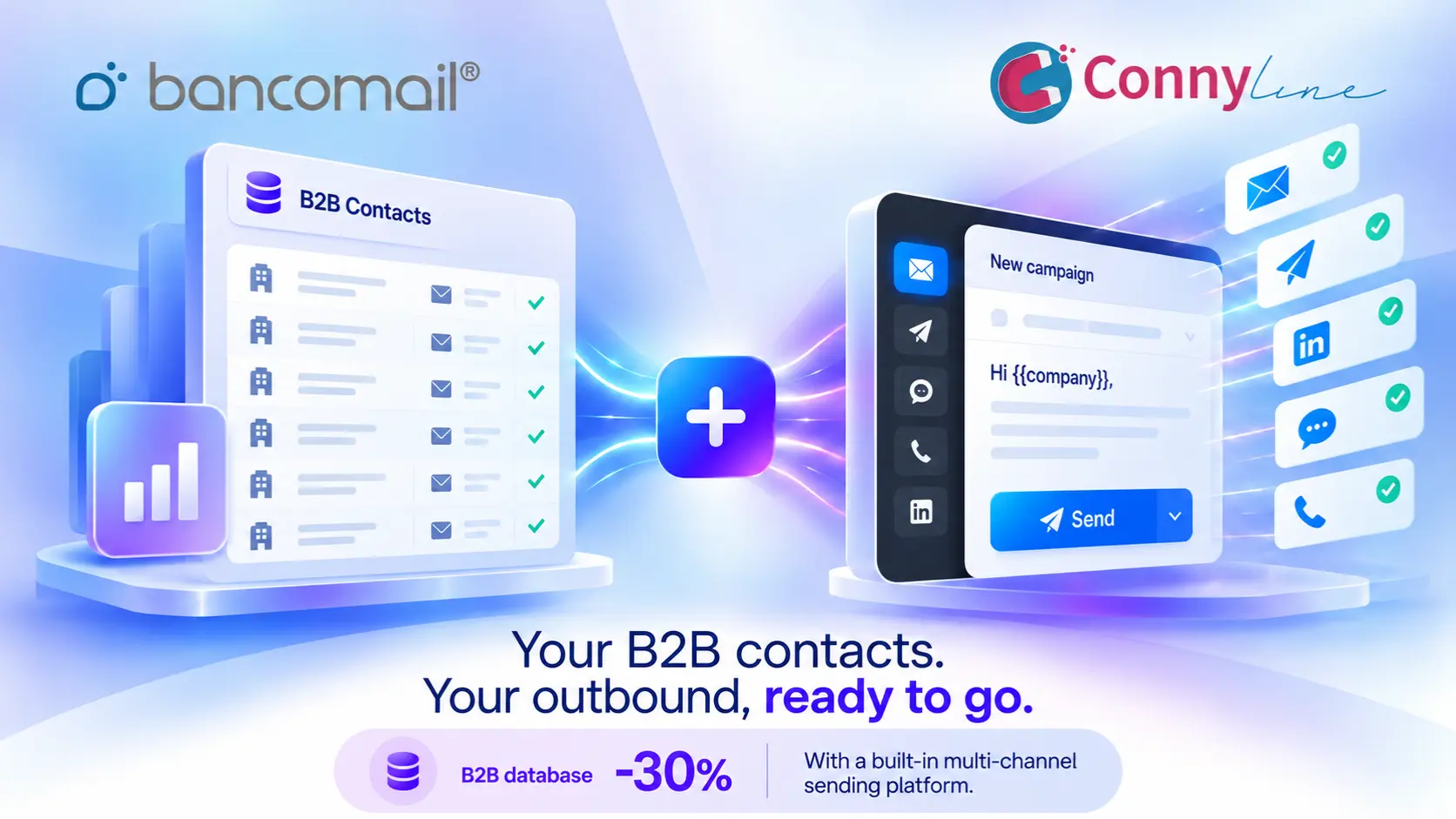
30% off + free ConnyLine sending plan
Get your next B2B database with 30% off. Plus, thanks to the partnership with ConnyLine, you'll receive a free ConnyLine plan for your first send, at no extra cost. Offer valid until October 25, 2026.
Offer valid on orders placed between September 22 and October 25, 2026. The included ConnyLine plan must be requested within 60 days of purchase and stays active for 3 months from activation. See the promotion's terms and conditions.B2B email guideB2B email around the world: what you can send, country by country
The rules on commercial email (DEM, direct email marketing) in B2B change from country to country, above all on one point: whether writing to a company is different from writing to a private individual. In Italy, Germany and Spain prior consent is required even when writing to companies. In France and Ireland companies can be contacted on an opt-out basis. In the United States opt-out is enough for everyone. Bancomail's guide compares 17 countries, updated to .
B2B recipient
CompanyEmailFirst contactcompany@domain.comConsent checkB2B first-contact email- ✓RelevanceSuitable recipient
- ✓First contactIntroduce yourself before making an offer
- Country rulesLocal requirementsUnder review
Current market
CACanadaOutcome
Allowed if relevantUSUnited StatesAllowed for everyone, with opt-outGBUnited KingdomAllowed for companies, with opt-outFRFranceAllowed for companies, with opt-outConsent pathThe same email, different paths. 17 countriescompared11 millionrecords in the Database7 sectionsof the transparent privacy noticelast updatedB2B cold email: three steps to write with results and in compliance
Whatever the country, the path is the same: relevance, first contact, permission. Writing cold with respect means offering something the reader cares about, introducing yourself clearly and always leaving a simple way out. The rules of almost every country ask for these same points; what changes is how strictly each step is regulated.
1Relevance: the right recipient
Choose who to write to and through which channel. The choice of recipient must be based on the recipient's suitability.
2First contact: introduce yourself before making an offer
Introduce yourself before making an offer. The rules change with the channel: for email they are stricter than for phone and post.
3Permission: it comes later, when the recipient listens
It comes later, when the recipient chooses to listen: a sign-up, or consent to stay in touch.
Ask for permission to communicate: the first contact is where it all begins.
The contacts in the Bancomail Database put you in a position to obtain permission: they take your message to the right people. Give your first message a simple next step, such as a sign-up page or a contact form, so that anyone interested knows how to continue.
Cold emailing with Bancomail: 11 million records of companies and professionals
Bancomail lists draw on a Database of over 11 million records of companies, associations and freelancers, acquired in compliance and with a certified supply chain. 75% of the records are companies and organisations with generic or department addresses; 25% are contacts attributable to a natural person.
Clear-cut case: companies and organisations Mixed case: contacts attributable to a natural person75%Clear-cut caseCompanies, associations and organisations
Corporations, limited companies, partnerships and other legal forms, with generic (
info@) or department (marketing@,sales@) addresses.25%Mixed caseContacts that identify a natural person
Two patterns:
[email protected]and[email protected]. The second is typical of self-employed professionals working alone. Professional partnerships remain in the clear-cut case.B2B commercial email rules in 17 countries: the overview
For each country the table shows the basic rule, whether companies are treated differently from private individuals, and whether as a first contact you can send the transparent privacy notice or the commercial email (DEM, i.e. promotional email).
Consent firstAllowed if relevantAllowed for companies, with opt-outAllowed for everyone, with opt-outGeneral data protection law appliesEurope Country Companies vs. private individuals B2B first-contact email Notes Privacy notice Sales Rule Italy No Yes No Consent first Italy: DEM (promotional email) requires prior consent, even towards companies. Germany No Yes No Consent first Germany: DEM (promotional email) requires prior consent, even towards companies. Spain No* Yes No Consent first Some argue there is leeway for DEM to generic mailboxes: a disputed position. France Yes Yes Yes Allowed for companies, with opt-out For DEM the message must relate to the recipient's profession. Generic mailboxes are company addresses. Belgium Yes Yes Yes Allowed for companies, with opt-out For DEM, impersonal mailboxes (info@, sales@) are free to use. Named addresses require consent. United Kingdom Yes* Yes Yes Allowed for companies, with opt-out Sole traders and some partnerships are protected like private individuals. Ireland Yes Yes Yes Allowed for companies, with opt-out This applies to addresses used for business, including named ones, if the message relates to that business. Netherlands Yes* Yes Yes Allowed for companies, with opt-out Debated interpretation: some hold that the address must be intended to receive commercial offers. Rest of the world Country Companies vs. private individuals B2B first-contact email Notes Privacy notice Sales Rule United States Not required Yes Yes Allowed for everyone, with opt-out No prior consent for DEM, but truthful sender and subject, a postal address and unsubscribe within 10 business days. Canada Yes* Yes Yes Allowed if relevant Address published without restrictions and a message relevant to the role. The regulator interprets this narrowly. Australia Yes Yes Yes Allowed if relevant Work address conspicuously published and a relevant offer. Publication alone is not enough. Japan Yes Yes Yes Allowed if relevant DEM requires opt-in, except for addresses made public online for business or provided in writing, such as on a business card. Israel Partly Yes No Consent first DEM requires consent, even towards companies; the law allows a single non-advertising contact with them to offer to send communications. Brazil Not regulated* Yes Yes General data protection law applies For DEM the LGPD applies, with consent or legitimate interest, plus a self-regulatory code with opt-out. Argentina Not required Yes Yes Allowed for everyone, with opt-out No prior consent for DEM, but every message must prominently offer removal from the database, with "Publicidad" in the subject and the legal text quoted in Spanish. On request, the source of the data must be disclosed. China No Yes No Consent first Sending DEM without consent or request is prohibited, even to companies. Subject line with "AD" and a valid contact to refuse further mailings. United Arab Emirates Unclear Yes No Consent first** The data protection law requires consent for DEM. For generic company mailboxes the picture is unclear. The DIFC and ADGM free zones have their own rules. * Debated position or non-uniform interpretation: details in the Notes column.
** Recent or evolving regulatory framework, currently being verified.
Transparent privacy notice: the standard we recommend for first contact in every country
The transparent privacy notice is the introductory message to send before making an offer. Whether it is mandatory or not, it is the best way to reach the inbox, build trust and convert. It consists of seven sections.
1Sender and subject2About us3Where the contact comes from4Why we are writing to you5Data deletion6Rights and contacts7Footer with company detailsSix ready-to-use templatesThree for product companies and three for service companies, customisable in colours, logo and tone.
Choose the template, copy the HTML and send it from your platform. Go to the templates1Sender and subject
A recognisable company name and a subject line that says what the message is.
An informative subject, never a promotional one. Send from the company mailbox.
2About us
Two lines on who you are and what you do, with a link to your website.
Describe, don't sell: no prices, offers or calls to buy.
3Where the contact comes from
The data source, cited in full with a link.
In Europe it is mandatory; everywhere it is the strongest sign of transparency.
4Why we are writing to you
What you use the contact details for and on what legal basis, with one or two lines on the products you would like to offer, a link to who you are and a link to the product page.
Descriptive, not promotional: the links leave the next step to those who are interested, and the path takes its course.
5Data deletion
A clearly visible link to request deletion of the data.
No request for consent: those who are interested can reply to the email or continue via the links, those who are not delete their data with one click.
6Rights and contacts
Access, rectification, erasure, objection, and who to write to in order to exercise them.
The rights apply to everyone, in every country, even where the law does not require them.
7Footer with company details
Company name, address, tax identifiers.
In the United States the postal address is mandatory; everywhere it reassures.
Every six monthsAn informative reminder every six months, for as long as the data remains on file.In their languageThe same template, translated into the recipient's language.Adaptable toneWhere DEM is allowed, the introduction can be warmer and more commercial.Frequently asked questions about B2B email
Are the rules on B2B commercial email the same in every country?
No. They differ above all on whether writing to a company is different from writing to a private individual. In Italy, Germany and Spain prior consent is required even when writing to companies. In France and Ireland companies can be contacted on an opt-out basis. In the United States opt-out is enough for everyone.
Is consent required to send a promotional email to an Italian company?
Yes. In Italy a DEM (promotional email) requires prior consent, even when the recipient is a company. As a first contact you can send the transparent privacy notice.
Which countries require prior consent for DEM?
In Bancomail's guide, prior consent is required by Italy, Germany, Spain, Israel, China and the United Arab Emirates. In Spain some argue there is some leeway for generic mailboxes, but the position is disputed.
How do you cold email a B2B contact in compliance?
With three steps that apply in every country: relevance (choosing a suitable recipient), first contact (introducing yourself before making an offer) and permission (it comes later, when the recipient chooses to listen). What changes is how strictly each step is regulated by the country's law.
What is the transparent privacy notice?
It is the introductory message to send before making an offer. It has seven sections: sender and subject, who we are, where the contact comes from, why we are writing to you, data deletion, rights and contacts, footer with company details. Bancomail recommends it in every country, even where it is not mandatory.
What is Permission Marketing?
It is the method coined by Seth Godin in 1999 as an alternative to interruption marketing. It builds a quality relationship with customers and prospects, based on their consent to receive anticipated, personal and relevant information.
How many records does the Bancomail Database contain?
Over 11 million records of companies, associations and freelancers. 75% are companies and organisations with generic or department addresses, 25% are contacts attributable to a natural person.
This Bancomail guide offers a general overview and does not constitute legal advice. Rules evolve and every country has its own specifics: the choice of channel and sending method rests with the sender, who must check the rules of the recipients' country. Last updated: .
- ✓